

Photoperiod cannabis plants flower when their light schedule changes, while autoflower plants start flowering automatically after a few weeks. Autoflowers grow faster and are easier for beginners, but photoperiods offer more control, larger yields, and better training options for experienced growers.
But how do you know which type of plant fits your growing style, space, and goals best?
Let’s get into that.
Differences Between Autoflower and Photoperiod Cannabis Plants
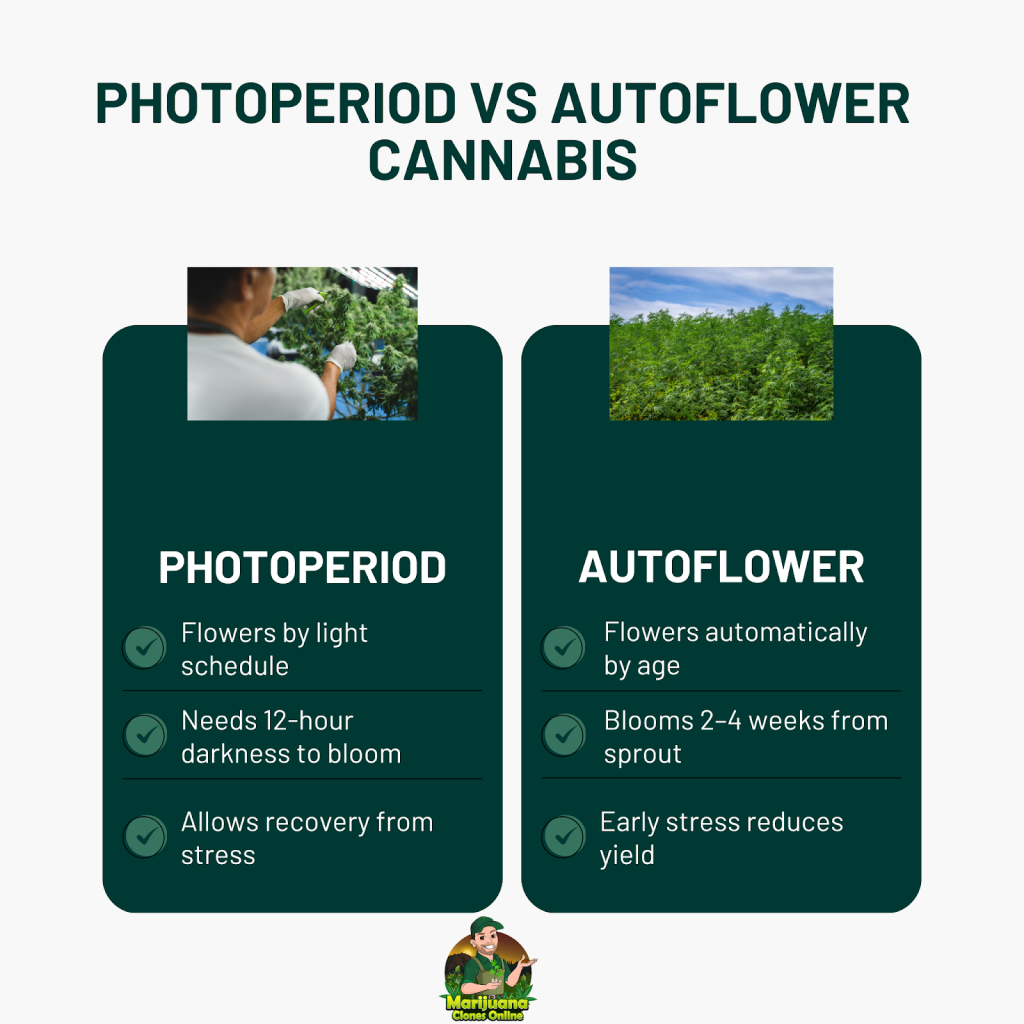
The type of cannabis plant you grow will shape your entire cultivation process. Autoflower and photoperiod strains follow different biological rules, and those rules influence everything from how you set up your lights to how you manage your harvest timeline.
Before you start your next run, it makes sense to get clear on how these plant types actually work.
Let’s break it down.
Light Dependency
Light control is the biggest factor that separates photoperiod and autoflower cannabis. Photoperiod plants rely on specific light cycles to move between growth stages. They stay in vegetative growth under eighteen hours of light and start flowering when the light schedule shifts to twelve hours on and twelve hours off.
That cycle gives growers the power to decide when the plants begin flowering, allowing complete control over size and shape before bloom begins.
Autoflower cannabis follows its own internal clock. It does not respond to light cycles in the same way. These plants begin flowering automatically after a few weeks of growth, no matter how much light they receive. Growers often keep lights on eighteen to twenty hours a day through the full cycle, which helps autos reach their full potential without wasting time on dark periods.
This difference defines how growers design their environments. Photoperiods demand strict light management and dark-room precision. Autoflowers can thrive under less controlled conditions because light leaks or outdoor exposure do not interrupt their flowering stage.
Growth Timeline
Timing your grow is one of the most important choices you’ll make. Photoperiod plants give you flexibility. You decide how long they stay in veg by controlling the light schedule. Some growers keep them in veg for four weeks. Others let them ride for eight or more to build massive size before flipping to flower. Flowering usually takes another eight to ten weeks, depending on the strain.
Autoflowers move on their own timeline. Most begin flowering between week two and week four, no matter how much light they get. The entire cycle wraps up in as little as eight weeks, though some can push ten to twelve. There’s no pause button and no option to extend veg time.
Growers working on tight timelines often lean toward autos. These plants offer faster turnaround and fit well into short seasons or rapid indoor rotations. Photoperiods demand patience, but they reward it with greater control and larger structure. That’s why serious cultivators often use them to dial in training techniques or maximize production.

Feeding & Maintenance Needs
Photoperiod plants have the resilience and time to handle aggressive feeding. They respond well to nutrient-rich programs, especially during veg. You can correct mistakes along the way because the plant is not locked into a set timeline. That flexibility gives experienced growers room to fine-tune everything from nitrogen levels to micronutrient ratios without rushing.
Autoflowers are different. These plants move fast and leave no room for recovery once flowering begins. Heavy feeding can overwhelm them, especially early in the cycle. Most autos prefer lighter nutrient regimens and balanced formulas that support smooth development without causing burn or lockout. Once they flip to flower, you need to have everything dialed in.
You also need to stay on top of transplant timing and root health. Autoflowers do not recover well from transplant shock. If you move them too late or damage the root zone, they might flower early or stop growing entirely. Photoperiods handle that stress better because they can remain in veg until fully recovered. For new growers or anyone still dialing in their environment, photoperiods provide a safer window to learn and adjust.
Yield Potential
The amount of flower you harvest comes down to genetics, environment, and how much control you have during the grow. Photoperiod plants offer the highest potential yield. You can extend veg time, shape the canopy, and push the plant to fill the space before flipping to flower. That freedom allows for bigger, heavier harvests, especially when using techniques like topping, low-stress training, or scrogging.
Autoflowers grow on a fixed schedule and typically stay smaller. They yield less per plant, but that doesn’t always mean low production. In the right setup, growers can stagger multiple autoflowers or harvest several runs per season outdoors. This approach creates more frequent harvests, even if each individual plant produces less.
Growers working under plant count limits often prefer photoperiods. Fewer plants, each producing more, can lead to a larger overall return. Autoflowers shine in speed and simplicity but come with natural yield caps due to their smaller size and shorter life cycle. If maximum output per plant matters, photoperiods remain the standard.
Potency & Resin
Photoperiod plants have held the crown here for a long time. Their extended growth cycle allows trichomes to develop fully, and breeders have refined these genetics for decades. The result is flower that hits harder, tastes better, and delivers more resin for concentrates or hash production.
Autoflowers have made huge strides. Old-school autos were low in THC and lacked flavor, but newer genetics have changed that. Many autos now rival photoperiod strains in potency and aroma. Some reach THC levels over 25 percent, and they do it in under ten weeks. Still, the best photoperiods tend to produce denser, stickier buds with more complex terpene expression.
For growers focused on quality and consistency, photoperiods provide more opportunities to enhance resin and potency through environment and training. Autoflowers perform best when you set them up right from the start. They can deliver excellent results, but there is less room to steer them once they begin flowering.
Training Techniques
Photoperiods give you full control. You can top them, fim them, bend branches, or run full SCROG setups without rushing. The veg stage lasts as long as you want, so plants have time to recover and respond. This makes photoperiods ideal for growers who like hands-on methods and want to fine-tune every part of the canopy.
Autoflowers move quickly. That speed limits how much training you can do. Most growers stick to low-stress training, gently bending and tying down branches during the early weeks. High-stress training methods like topping or supercropping can stunt growth or trigger early flowering. If you top too late, the plant might not recover in time to produce a worthwhile yield.
Autoflowers reward timing and precision. Photoperiods reward creativity and control. If you enjoy shaping your grow and pushing your plants to perform, photoperiods offer the best canvas. If you want minimal maintenance and a quick, efficient cycle, autoflowers keep things simple while still delivering solid results.
How to Choose What’s Right for You
The right plant type depends on your setup, your experience level, and your goals. Instead of guessing, use these key areas to guide your decision.
Grow Environment
If you’re growing in a tent, a sealed room, or a dedicated indoor space where you can fully control the light schedule, photoperiods are a great fit. They give you the freedom to flip to flower when your plants are the exact size you want. If your space is shared, exposed to ambient light, or outdoors with unpredictable conditions, autoflowers make more sense. They are not affected by light leaks and keep flowering no matter the season.
Time and Commitment
Photoperiods require more time and attention. You have to manage light schedules, training techniques, and nutrient shifts over a longer cycle. If you’re running a tight schedule or looking for a quicker harvest, autoflowers can get you from seed to smoke in as little as eight weeks. This makes them useful for fast rotations or growers working around seasonal windows.
Goals for Yield and Quality
If your goal is to pull the most out of every plant and build a canopy that delivers dense, top-shelf buds, photoperiods offer the best tools for that. You can grow fewer plants and still hit your yield targets. If your goal is to keep the process simple and steady, or you want multiple harvests in a season, autoflowers let you do that efficiently.
Cloning and Consistency
Clones give you a head start and remove the guesswork. If you want consistent genetics and repeatable results, photoperiods are the way to go. Autoflowers cannot be cloned effectively because they start flowering based on age, not light schedule. Every run from seed brings new variables.
Skill Level
Autoflowers appeal to newer growers because they remove some of the complexity around light schedules. But that simplicity comes with tighter margins. One mistake early on can stunt growth or trigger premature flowering. Photoperiods give you more flexibility to learn as you go.
You can recover from mistakes, adjust training, and extend veg time if needed. If you’re still dialing in your environment or feeding schedule, that extra flexibility can save your harvest.
Still Can’t Decide? Here’s a Quick Checklist
Choose Autoflower If:
- You want fast harvests
- You’re short on space or stealth-growing
- You prefer simplicity and fixed timelines
- You don’t plan to clone or pheno-hunt
Choose Photoperiod If:
- You want max yield and training control
- You’re using clones or want to create them
- You care about terpene intensity and bud density
- You’re growing under a controlled light schedule
Ready to Grow like the Pros?

MCO offers elite, pest-free clones straight from phenohunted mother plants. Skip the guesswork and start your grow strong using genetics trusted by top cultivators.
Order your clones now and see the difference in yield, flavor, and consistency.