
Female marijuana plants grow buds rich in THC, while male plants develop pollen sacs that fertilize females and reduce flower quality. Growers remove male plants early in the cycle to prevent pollination, protect flower quality, and maximize their final yield.
But how can you tell if your cannabis plant is male or female before it’s too late?
That’s what we will be discussing today.
Read on to find out how to protect your yields and grow with confidence.
Male vs Female Marijuana Plants: Key Differences
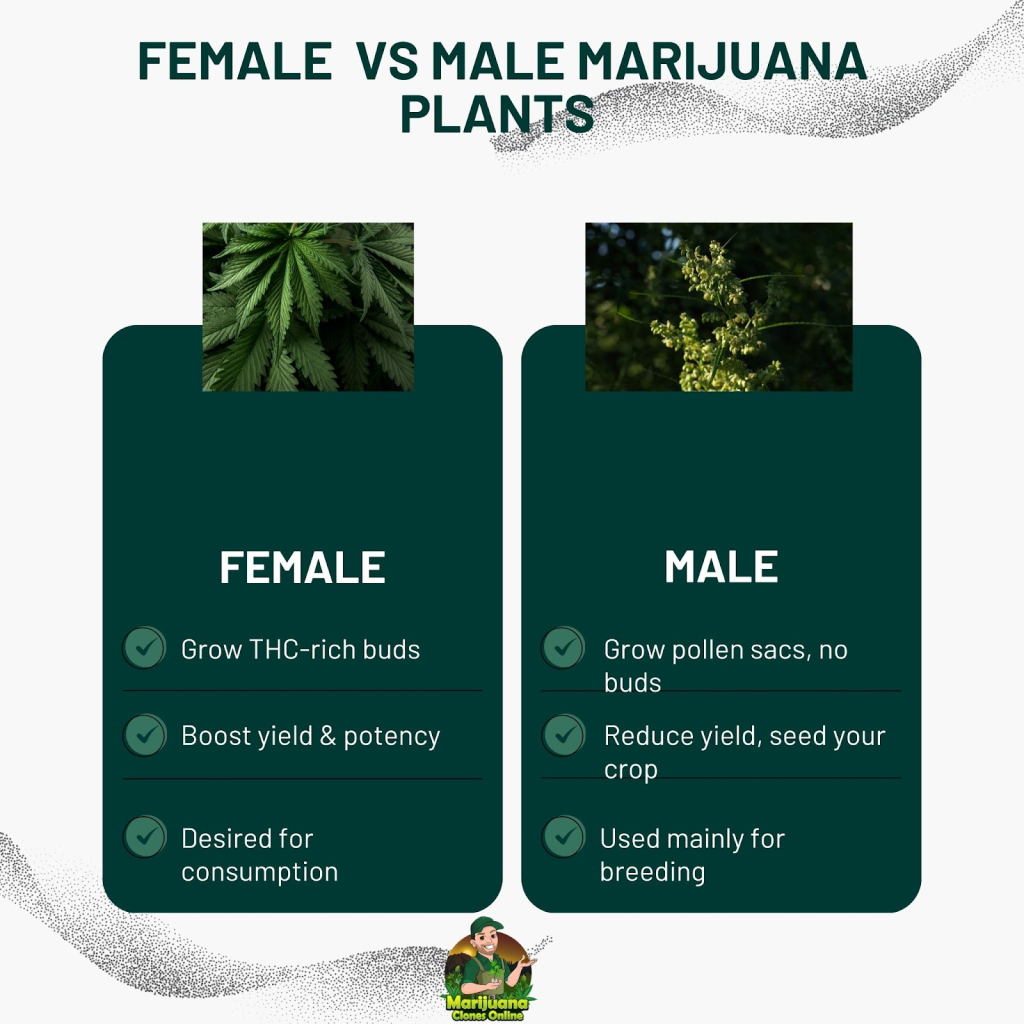
The difference between male and female cannabis plants is more than visual. It directly affects your yields, potency, and overall success as a grower. One type grows the buds we all want. The other can ruin an entire garden if it drops pollen.
Every serious cultivator needs to recognize these differences early and act with confidence.
Female Plants Grow the Buds You Want
Female marijuana plants are the ones producing the trichome-covered buds rich in THC and other cannabinoids. These are the flowers people smoke, press, or extract for concentrates. Every healthy female plant you keep in your garden adds to your final yield and overall potency.
Male Plants Form Pollen Sacs, Not Buds
Male plants never grow smokable flower. Instead, they grow pollen sacs, which are the small round balls that cluster around the nodes. If those sacs open, they release pollen that fertilizes nearby females. Once fertilized, those females will shift their energy into seed production and stop developing resin-heavy buds.
When Do Plants Show Their Sex?
You don’t need to wait until it’s too late to find out what your plant is. Your entire grow depends on catching the signs early. The moment your plants begin to reveal their sex is when your decision-making starts. This part of the process can make or break your outcome.
Timing Depends on Growth Stage and Genetics
Cannabis plants usually begin to show signs of sex between weeks four and six of the vegetative stage. That’s when pre-flowers start to form at the nodes. These tiny structures are your first visual clue. If you see white hairs (pistils), you have a female. If you see a ball-like sac, it’s male.
Photoperiod and Autoflower Timing
Photoperiod plants typically show sex once they’ve received 12 hours of darkness. This triggers flowering and helps reveal their traits more clearly. Autoflowers begin flowering based on age rather than light. Most autoflowers show sex between days 21 and 30.
If you grow regular (non-feminized) autoflowers, you still need to check for males. Feminized autos can still turn into hermaphrodites if exposed to stress.
How to Identify Sex Early
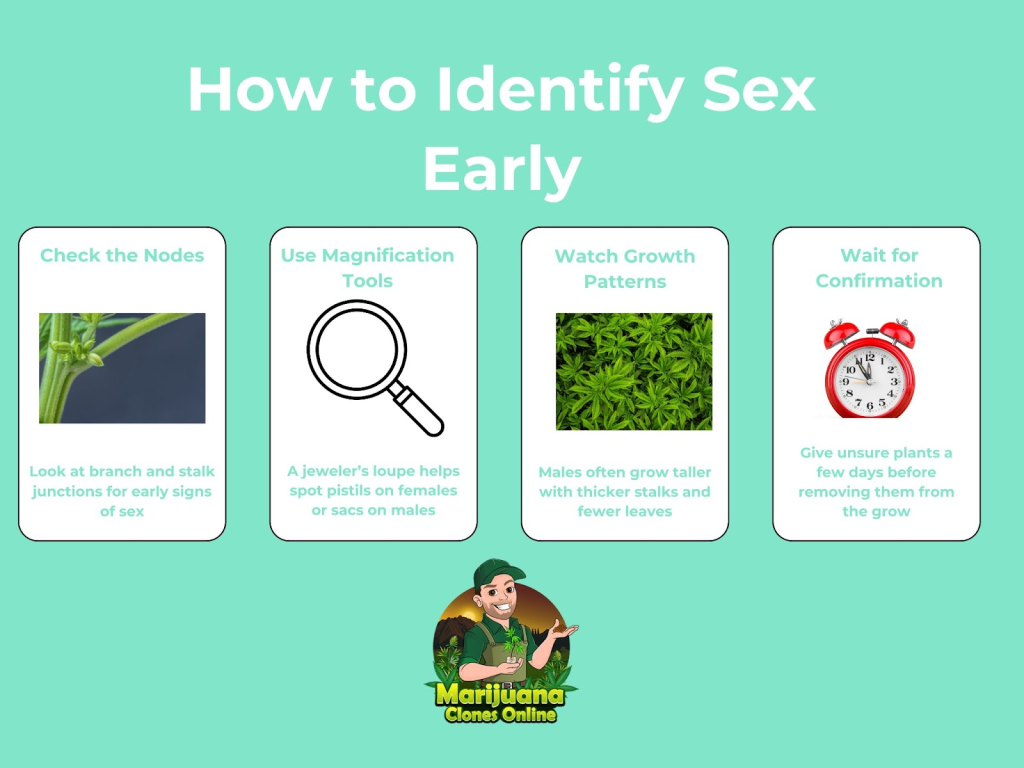
Spotting the sex of your cannabis plants early gives you more control, fewer surprises, and a better harvest. If you’re growing from seed, your window to act opens around week four. The earlier you can identify the males, the sooner you can remove them before they pollinate your females.
Here is how to do it:
Step 1: Look at the Plant’s Nodes
Start by inspecting the junctions where branches meet the main stalk. This is where pre-flowers begin to appear. You don’t need to flip your plants into flower to start seeing these signs, especially if they’ve had strong vegetative growth. Use this area as your first point of focus.
Step 2: Use a Magnifier
Pre-flowers are small, sometimes too small to see clearly with the naked eye. A jeweler’s loupe or handheld microscope will help you spot the difference between pistils and sacs. A female plant will show a teardrop-shaped calyx with a tiny white hair sticking out. A male will show a smooth, rounded sac with no pistil.
Step 3: Look for Growth Patterns
If a plant grows noticeably taller, develops fewer leaves, or stretches more than the others, it could be male. Male plants often mature faster and develop thicker stalks. These structural cues give you another angle when you’re unsure based on pre-flowers alone.
Step 4: Observe Flowering Speed
Males usually show sex one to two weeks earlier than females. If you see a plant developing early but not showing pistils, assume it’s male and keep a close eye. And if the sacs start to multiply and cluster, it’s time to remove the plant before pollen is released.
Step 5: Don’t Rush, Wait for Confirmation
Some growers mistake female calyxes for pollen sacs and remove healthy females too soon. Give your plants a few days if you’re unsure. Pistils will eventually emerge from a female calyx, confirming its sex. Acting too fast causes more damage than waiting an extra day.
Why Growers Remove Male Marijuana Plants
If your goal is a potent, seedless flower, there’s no room for males in your grow. One missed plant can pollinate an entire garden, shift your plant’s energy into seed production, and tank your final yield.
These are the reasons you should act fast when you spot a male.
Pollination Ruins Bud Quality
Once a female plant gets pollinated, it stops focusing on resin production and begins developing seeds. This leads to lighter, less potent buds and a sharp drop in overall cannabinoid content. That sticky, trichome-covered flower you’re aiming for? It doesn’t happen in a pollinated plant.
One Male Can Wreck an Entire Grow
Cannabis pollen is lightweight and airborne. It doesn’t stay local. A single male can pollinate every female in your tent, or worse, in your neighbor’s garden if you’re growing outdoors. Once pollen is released, you can’t reverse it. That’s why it’s important to act before it happens.
Accidental Pollination Wastes Resources
Feeding, training, and caring for a plant that turns out to be male costs time, nutrients, and canopy space. When that plant pollinates others, your entire investment suffers. You lose yield, potency, and weeks of progress. Many growers find out too late and end up with seeded, low-quality flower.
Mistaking a Female for a Male Also Hurts
Removing a female plant by mistake is just as bad. This happens when growers rely on guesswork or panic. The best approach is to wait for visible pistils. If a plant shows a calyx without hairs, give it a few more days. Once the pistils appear, you’ll know it’s worth keeping.
Seeds Add Cost and Uncertainty
Many growers using regular seeds end up tossing half their crop after identifying males. That’s money and time lost. If you’re working within plant count limits, like most people growing legally, wasting those slots on male plants is frustrating. Feminized seeds reduce this risk, but clones eliminate it entirely.
Do Male Plants Have Any Use?
Yes, male marijuana plants have value, but not for flower production. They’re essential for breeding, genetic development, and industrial applications.
If your focus is high-THC flower, you’ll remove males early.
But if you’re working on something more advanced, here’s where male plants come in.
Male Plants Provide Pollen for Breeding
Every cannabis strain ever created came from a male and a female. Males pass on half the genetic profile to the next generation. If you want to breed new strains or stabilize existing ones, you need strong male genetics. The best breeders preserve specific male plants for years based on traits like vigor, pest resistance, or growth speed.
Pollen Collection Requires Isolation
Saving pollen safely takes precision. You’ll need to isolate male plants in a separate grow space with zero airflow crossover. Once the sacs swell and begin to open, you can collect the pollen, store it in sealed containers, and later apply it to specific female plants. This is how targeted crossbreeding happens.
Some Male Traits Are Valuable
Male plants often grow taller, faster, and stronger than their female siblings. These traits can be useful for outdoor growers who want stronger stalks or better wind resistance.
In some cases, male plants carry unique terpene profiles that influence flavor and aroma in their offspring. These traits won’t show in flower, but they pass down through breeding.
Cannabinoid Levels Are Minimal
While male plants do contain trace amounts of cannabinoids, they don’t produce the dense trichomes that cover female buds. Some growers try to use male leaves or trim for low-potency edibles or extracts, but the results are weak. If you’re looking to make concentrates, males won’t help you.
Industrial Uses Exist Outside of THC Farming
In hemp farming, male cannabis plants are often used for fiber production. Their thick stalks and rapid growth make them ideal for textile applications. In this context, males have practical, commercial value. For high-THC home growers, though, they’re usually removed to keep the flower seed-free.
Can You Smoke Male Marijuana Plants?
Yes, you can smoke male marijuana plants, but you won’t get much out of them. Male plants don’t grow buds, and their cannabinoid levels are extremely low. If you’re after THC, flavor, or effects, male plants fall short. They’re not harmful, but they’re not helpful either when it comes to smoking or extracting.
Maximize Yields by Mastering Plant Sexing
If you want potent, high-yield cannabis, you need to control what stays in your grow. That starts with knowing the difference between male and female plants. Every male you remove early is a win for your final yield.
And every female you keep unpollinated brings you closer to top-shelf, seedless flower.
Male plants have a place in breeding and research. They offer value when used with intention, but they don’t belong in a flower-focused garden. Their pollen can destroy months of progress. Their buds won’t give you what you’re looking for. And keeping them around “just in case” is a gamble you don’t need to take.
The good news is that you don’t have to play guessing games. You can skip the stress, avoid the mistakes, and grow with complete confidence.
Tired of guessing if your plants are male or female? Start with guaranteed, feminized clones or XL Teens (12″+ plants) from Marijuana Clones Online and skip the risk.